Watermelon Game
📖 About the Game
What Is Watermelon Game?
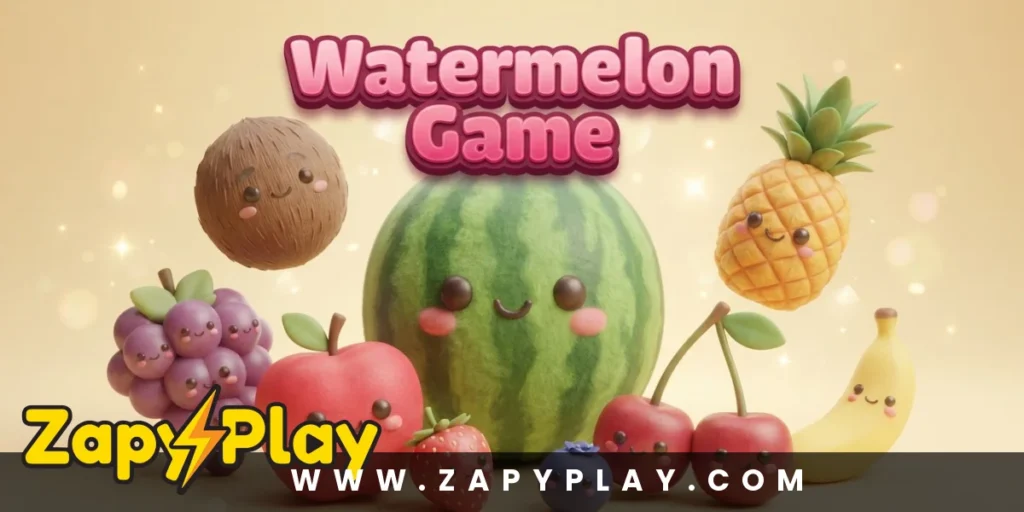
Watermelon Game is a physics-based puzzle game where players drop various fruits into a container, merging identical fruits to create progressively larger ones — ultimately aiming to produce a giant watermelon. The core gameplay loop is deceptively simple: position your fruit drop carefully, trigger chain merges, and keep the pile from overflowing the container. What sets it apart from similar casual titles is its satisfying emergent gameplay — small decisions compound into massive chain reactions that feel genuinely rewarding.
Originally rooted in a Japanese arcade concept known as Suika Game, it gained massive global popularity through streaming platforms and social media in late 2023. The browser version made it accessible to millions of players who wanted the experience without purchasing dedicated hardware. Its blend of puzzle strategy and idle satisfaction places it firmly at the crossroads of casual and skill-based gaming.
Why You’ll Love Playing Watermelon Game Online
Top Benefits of Playing Online
The browser version of Watermelon Game requires absolutely no download, no account creation, and no payment — you can jump into a session within seconds. This zero-friction entry point means you can play on a lunch break, during a commute on a tablet, or at a desktop without installing anything. It runs smoothly across Chrome, Firefox, Safari, and Edge, making cross-platform support genuinely seamless.
Unblocked access is another major draw. Many school and office networks that restrict gaming sites still allow lighter browser-based titles, and Watermelon Game’s small footprint and HTML5 architecture help it slip through where heavier games cannot. Whether you’re on a low-powered Chromebook or a high-spec laptop, performance stays consistent. The game’s casual pacing also means you can pause mentally at any moment — no checkpoints needed, no progress lost.
Game Features
Key Features & Mechanics
- Single-Player Drop Mechanic: The entire game revolves around a one-touch or one-click drop system where you position a fruit horizontally above the container — precision matters more than speed, and hesitation can cost you the run.
- Fruit Merge Chain Reactions: When two identical fruits touch, they merge into the next size up, from cherry all the way to watermelon; a single well-placed grape can trigger a cascade of four or five simultaneous merges.
- Physics-Driven Stacking: Powered by a realistic physics engine, every fruit rolls, bounces, and settles differently, meaning no two games play out identically even when you drop in the same sequence.
- Accessibility for All Ages: The rules can be understood in under thirty seconds, making it ideal for younger players and older casual gamers alike without any steep learning curve.
- Short to Medium Session Length: A typical run lasts anywhere from two to fifteen minutes depending on skill level, fitting perfectly into quick-break play or extended casual sessions.
- Browser and Mobile Platform Support: The HTML5 build works on desktop browsers and mobile browsers without any separate app download, giving you the same experience across devices.
- High Score Leaderboard Motivation: The game tracks your personal best score, creating a persistent meta-goal that keeps players coming back to beat their previous run — a subtle but effective idle-style progression hook.
How Watermelon Game Compares to Similar Puzzle, Casual, Idle, Kids Games
Genre Comparisons & Differences
Compared to classic falling-block puzzle games like Tetris, Watermelon Game introduces organic, unpredictable physics rather than rigid grid-based placement. That unpredictability is both its challenge and its charm — a fruit can roll slightly off target and ruin a perfect setup, which Tetris’s locked-grid pieces never do. It demands a different kind of spatial thinking, one that accounts for momentum and bounce rather than pure geometry.
Against match-three casual games popular on mobile platforms, Watermelon Game feels more tactile and immediate. Match-three games often rely on pre-set boards and swap mechanics, while this title gives you full positional control with every single drop. That agency makes victories feel earned rather than luck-dependent, which is a meaningful distinction for players who find traditional match-three games too passive.
In the idle and casual space, games like bubble shooters offer a similar one-action-per-turn rhythm, but they lack the compounding tension of a pile that visibly grows toward the danger line. Watermelon Game adds genuine stakes to each drop in a way that pure idle titles rarely achieve. If you enjoy games that blend quick reflexes with relaxed strategy, you might also appreciate Happy Wheels for its equally physics-driven, unpredictable gameplay sessions.
Game Modes
Classic Mode
Classic Mode is the standard single-player experience where you drop fruits one at a time into the container and aim for the highest possible score before any fruit breaches the top boundary. The challenge escalates naturally as larger merged fruits take up more space, forcing increasingly careful placement. There are no time limits in Classic Mode — the pressure is entirely self-generated by the growing pile, which suits players who prefer strategic thinking over speed.
Endless / Relaxed Mode
Some browser versions of Watermelon Game offer a relaxed variant where the game-over condition is softened or removed, allowing players to experiment with drop positions and merge chains without punishment. This mode is especially useful for new players learning how fruits interact physically before committing to competitive score runs. It functions almost like a sandbox, letting you study how a pineapple’s bulk displaces smaller fruits and plan chain strategies in low-stakes conditions.
Challenge Mode
Challenge Mode introduces pre-set starting conditions — the container may already have several fruits placed at the start, requiring you to manage an existing mess from the first drop. This mode tests adaptability rather than clean-slate planning, rewarding players who can read a chaotic arrangement and find the one gap that triggers a clearing chain reaction. Scores in Challenge Mode often differ dramatically from Classic runs because the opening state is never neutral.
Tips & Tricks to Win at Watermelon Game
Proven Strategies & Pro Tips
- Always work from the edges inward: Placing smaller fruits along the container walls first creates a natural funnel that guides larger merged fruits toward the center. When the center fills with big fruits, you have wall space left as a buffer — dropping a cherry into an already-packed center without wall support almost always destabilizes the pile.
- Prioritize same-size pairs near the top: If two identical fruits are sitting near the overflow line, merging them immediately reduces height by converting two items into one larger one that typically settles lower. Ignoring a high pair to chase a deeper merge is a common mistake that ends runs prematurely.
- Use the next-fruit preview to plan two moves ahead: The game shows you the upcoming fruit before you drop the current one — use that information to set up your current drop as a platform for the incoming piece rather than reacting move by move. Players who only think one drop ahead rarely surpass mid-tier scores.
- Let physics settle before your next drop: After a large merge, wait a second for the resulting fruit to stop rolling before placing the next one. Dropping onto a still-moving fruit adds unpredictable bouncing that frequently knocks a stable pile off-balance, and impatience is the single biggest cause of preventable game-overs.
- Build toward the watermelon from one side: Rather than distributing large fruits evenly, try accumulating your biggest merged fruits on one side of the container, creating a dense stable mass. This keeps the other side open for smaller fruits and gives you a predictable landing zone for the final watermelon merge, which requires the most horizontal space of any combination in the game.
Who Is Watermelon Game For?
Target Audience & Player Fit
Watermelon Game is genuinely one of the few titles that works for nearly every type of casual player. Kids as young as five or six can grasp the drop-and-merge concept, while adults find the high-score chase and physics unpredictability engaging enough for repeated sessions. It requires no reading ability and no complex button combinations, which removes virtually every barrier for young players.
For office workers or students looking for a mental reset during a short break, this game fills exactly ten minutes without demanding a longer commitment. It doesn’t punish you for stopping mid-session — every game is self-contained, and there’s no story progression or time-limited event pressuring you to keep playing. Players who enjoy idle games for their low-stress loop will find the merge mechanic scratches a very similar itch with slightly more active engagement.
Why Watermelon Game Is One of the Best Free Online Games to Play
Final Verdict & Recommendation
From a design standpoint, Watermelon Game succeeds because its single mechanic — drop, merge, stack — scales in complexity entirely through the player’s own decisions rather than artificial difficulty spikes. The physics engine does the heavy lifting, creating genuine variety without the developers needing to build multiple systems or enemies. That design elegance is rare in browser gaming, where most casual titles either over-complicate or under-deliver.
On accessibility, few free browser games match this title’s combination of instant load times, no-login play, and genuine cross-device performance. The replayability is equally strong — because each run is physically unique and the high score board always offers a personal target to chase, returning players always have a reason to drop one more fruit. Jump in right now and see how high you can stack before that first watermelon appears.
Frequently Asked Questions About Watermelon Game
What exactly is Watermelon Game and how does it work?
Watermelon Game is a physics-based puzzle game where you drop fruits into a container and merge identical ones to create larger fruits, with the watermelon being the largest and most valuable. The game ends when any fruit overflows the top of the container. Your score is calculated based on the total value of all fruits merged during the run.
How do you create a watermelon in the Watermelon Game?
To create a watermelon, you need to merge two pineapples, which are themselves the result of merging two melons, and so on up the fruit chain. The full merge sequence runs from cherry through strawberry, grape, dekopon, persimmon, apple, pear, peach, pineapple, melon, and finally watermelon. Achieving the final merge typically requires careful management of space throughout the entire run.
Is Watermelon Game free to play and does it require a download?
Yes, the browser version of Watermelon Game is completely free to play and requires no download or installation whatsoever. You simply open it in any modern web browser and start playing immediately. There are no paywalls, premium features, or mandatory account registrations in the free browser version.
Can you play Watermelon Game on mobile devices?
The HTML5 browser version of Watermelon Game is fully compatible with mobile browsers on both iOS and Android devices. The touch controls map naturally to the drop mechanic — you tap or drag to position the fruit and release to drop it. No separate mobile app is required, though a dedicated app version also exists on some platforms for offline play.
What is the highest possible score you can achieve in Watermelon Game?
The theoretical maximum score in Watermelon Game is achieved by creating a watermelon and continuing to maximize merges of every fruit type before the game ends, with top players regularly reaching scores above 3,000 points. In practice, scores above 2,000 are considered strong, and anything above 2,500 places you in the upper tier of casual players. The exact ceiling depends on the specific version’s scoring formula, but the watermelon merge alone contributes a substantial points spike.
You May Also Like
Check out these awesome games from our collection:
🎮 How to Play
Position Your Fruit
Move your mouse or drag your finger left and right above the container to position the current fruit exactly where you want it to land. Precision here determines whether you trigger a merge or create a problematic gap.
Drop the Fruit
Click the mouse button or release your touch to drop the fruit straight down into the container. The fruit will fall, roll, and settle based on the physics of whatever is already in the container below it.
Trigger Merges
When two identical fruits touch each other, they automatically merge into the next larger fruit. Position your drops to place matching fruits adjacent to each other and trigger chain reactions for maximum score.
Manage Your Stack Height
Keep an eye on the overflow line at the top of the container. If any fruit crosses that line and stays there, the game ends. Prioritize merges that reduce height whenever the pile gets dangerously close to the boundary.
Chase the Watermelon
Work your way up the fruit size chain by consistently merging pairs. The ultimate goal is to produce a watermelon — the largest fruit — which awards the highest single-merge point value in the game.
⌨️ Keyboard Controls
⚡ Pro Tips
- Stack smaller fruits along the container walls first to keep the center clear for larger merges — this buys you critical vertical space as the game progresses.
- Always watch the next-fruit preview and plan your current drop as a setup for the incoming piece rather than reacting to each fruit independently.
- After a large merge causes a fruit to roll, wait for all physics movement to fully settle before dropping your next piece to avoid unpredictable pile collapses.
- When two large identical fruits are near the overflow line, merge them immediately — the resulting single fruit almost always settles lower and relieves dangerous height pressure.
- Build your largest merged fruits on one side of the container to create a stable anchor mass, leaving the opposite side open as a controlled landing zone for smaller incoming fruits.