FreeCell
📖 About the Game
What Is FreeCell?
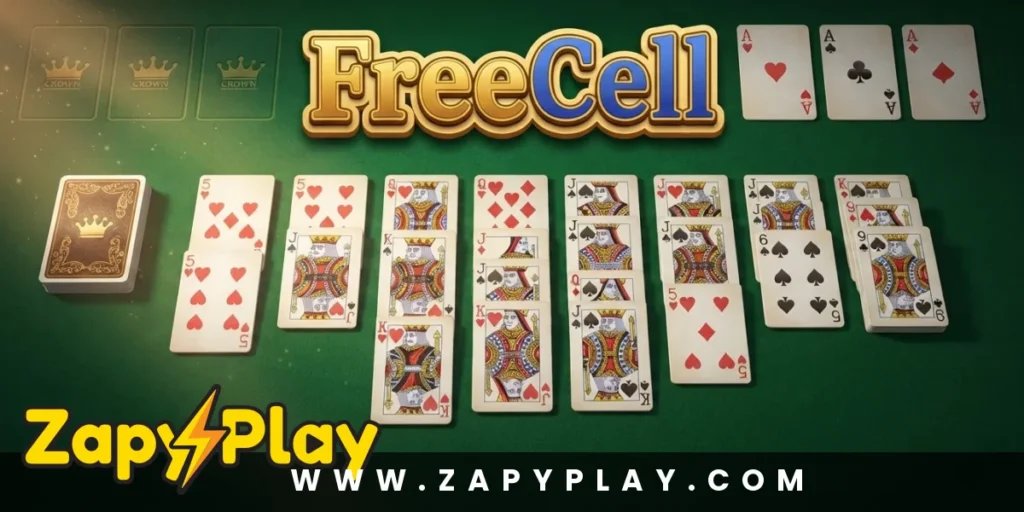
FreeCell is a strategic solitaire card game that combines skill with careful planning, distinguishing itself from luck-based variants through its almost entirely solvable nature. Players work with a standard 52-card deck dealt face-up across eight cascading columns, tasked with building four foundation piles by suit from Ace to King. Unlike traditional Klondike solitaire, every card is visible from the start, transforming each game into a pure logic puzzle rather than a gamble.
The game rose to mainstream popularity when Microsoft bundled it with Windows 95, introducing millions to its addictive blend of accessibility and depth. What sets this title apart is its mathematical elegance: researchers have proven that nearly all of the 52! possible deals are winnable with perfect play. The four “free cells” in the upper-left corner serve as temporary holding spots, creating a tactical layer that rewards forward-thinking over impulsive moves.
Why You’ll Love Playing FreeCell Online
Top Benefits of Playing Online
Browser-based versions eliminate the need for downloads or installations, letting you dive into a game within seconds on any device. The online format preserves your progress automatically and often includes unlimited undo functions that paper cards simply can’t offer. Most platforms provide unblocked access, meaning you can enjoy quick sessions during work breaks or extended puzzle-solving marathons without restrictions.
Cross-platform support ensures your experience transitions seamlessly between desktop, tablet, and smartphone. Many online implementations track your statistics, win rates, and solving times, adding a competitive edge that motivates continuous improvement. The free-to-play model removes all barriers to entry while maintaining the pure gameplay that made this card game a timeless classic.
Game Features
Key Features & Mechanics
- Single-player puzzle gameplay where you manipulate visible cards across eight tableau columns, four foundation piles, and four temporary free cells to achieve victory through complete suit sequences. The transparent dealing system ensures every challenge stems from strategy rather than hidden information.
- Unlimited undo functionality allows you to experiment with different move sequences without penalty, encouraging bold tactical experimentation and helping newcomers learn optimal strategies through trial and refinement.
- Session length adapts to your schedule, with games typically lasting between three and fifteen minutes depending on deal difficulty and your familiarity with advanced techniques like supermoves and cascading sequences.
- Platform support spans all modern browsers without plugins, plus dedicated mobile apps that maintain full functionality through intuitive touch controls optimized for smaller screens and one-handed play.
- Daily challenge modes present curated deals that all players worldwide attempt simultaneously, creating a shared competitive experience where you can compare your solution efficiency against a global leaderboard.
- Auto-complete detection recognizes when victory becomes inevitable and automatically plays out remaining moves, respecting your time by skipping the tedious final card placements once strategic decisions are complete.
How FreeCell Compares to Similar Arcade Games
Genre Comparisons & Differences
Spider Solitaire demands building sequences within the tableau itself rather than moving cards to external foundations, creating a different spatial puzzle that emphasizes column management. FreeCell’s visible dealing and free cell mechanics make it more approachable for beginners while maintaining strategic depth. The ability to see all cards from the outset reduces frustration compared to games where hidden cards can create unsolvable situations.
Pyramid Solitaire uses a matching mechanic where pairs totaling thirteen get removed, creating a completely different cognitive challenge focused on number combinations. This title instead emphasizes sequencing and resource management through its temporary holding cells. Players who enjoy logic puzzles similar to Skribbl.io‘s pattern recognition will appreciate how each deal presents a unique problem with a methodical solution path.
TriPeaks offers faster-paced gameplay with simpler rules that prioritize quick decisions over deep planning. The arcade-style nature of that variant contrasts sharply with the methodical, chess-like thinking this game rewards. While both provide satisfying card-clearing mechanics, FreeCell’s complete information state makes it ideal for players who prefer eliminating luck and testing pure problem-solving abilities.
Game Modes
Classic Mode
This standard experience presents randomly generated deals from the vast library of possible configurations. Your objective remains consistent: build all four foundation piles from Ace through King in ascending suit order. The mode tracks your win percentage and average completion time, providing clear metrics for measuring improvement as you internalize common patterns and develop intuition for complex positions.
Daily Challenge Mode
Every 24 hours, a new curated deal becomes available to players globally, creating a shared puzzle-solving experience. You compete not just for completion but for efficiency, with leaderboards ranking players by move count and solution time. This mode adds social competition to the traditionally solitary experience, motivating you to refine strategies and discover optimal solutions rather than merely workable ones.
Numbered Deal Mode
Access any specific deal from the game’s vast library by entering its unique identifier, allowing you to replay favorite challenges or attempt notoriously difficult configurations. This mode proves invaluable for studying advanced techniques, as you can revisit the same position multiple times to test different approaches. Friends can share deal numbers to collaborate on particularly tricky puzzles or challenge each other to beat solution times.
Tutorial Mode
Simplified deals with progressive difficulty teach fundamental concepts like building sequences, utilizing free cells effectively, and recognizing dead-end positions before committing moves. Interactive hints highlight available moves and explain the strategic reasoning behind optimal choices. This guided experience transforms raw rules into practical skills, ensuring newcomers develop solid foundations rather than reinforcing bad habits through trial and error.
Tips & Tricks to Win at FreeCell
Proven Strategies & Pro Tips
- Empty columns are more valuable than free cells because they can hold entire sequences rather than single cards. Prioritize creating empty tableau columns early in the game, even if it requires using all four free cells temporarily. When you need to move a King to an empty column, that position becomes a powerful staging area for building long sequences and untangling complex positions.
- Always move Aces and Deuces to foundations immediately since they never block useful plays in the tableau. This simple habit clears clutter and prevents you from accidentally burying these essential starting cards beneath longer sequences. However, resist the urge to rush all low cards upward—sometimes keeping a Three or Four in play provides necessary sequencing flexibility for manipulating higher cards.
- Think three moves ahead before committing to any action, mentally simulating the resulting position and checking whether it creates new possibilities or dead ends. This combinatorial game theory approach transforms reactive play into strategic mastery. For example, before moving a Red Jack onto a Black Queen, verify you have a Black Ten available to continue the sequence or risk stranding valuable cards.
- Fill free cells in reverse priority order, reserving at least one empty cell until absolutely necessary to maintain maximum tactical flexibility. Each occupied free cell reduces your ability to perform supermoves and limits options for untangling problematic sequences. When forced to use all four cells, focus immediately on freeing at least one through foundation builds or sequence consolidation.
- Avoid burying high cards beneath lower-ranked cards in the same suit, as this creates dependency chains that severely constrain future moves. If you place a Ten of Hearts under a Seven of Hearts, you must clear that Seven before accessing the Ten, potentially stranding multiple cards. Careful attention to suit relationships prevents these self-inflicted obstacles that turn winnable deals into frustrating stalemates.
- Recognize when to abandon foundation building temporarily and focus on tableau manipulation instead, especially during mid-game complexity when creating empty columns unlocks more strategic value. The foundations aren’t going anywhere, but burying a crucial card beneath an unmovable sequence can instantly doom an otherwise winnable deal. Balance foundation progress with maintaining tableau flexibility rather than blindly moving every available card upward.
Who Is FreeCell For?
Target Audience & Player Fit
This game perfectly suits players who prefer strategic thinking over twitch reflexes, offering mental stimulation without time pressure or stressful mechanics. Adults seeking productive breaks during work or study sessions appreciate the clean start and finish each game provides. The difficulty curve welcomes complete beginners while offering expert-level challenges that keep veterans engaged for years, making it ideal for anyone who enjoys puzzle-solving regardless of gaming background.
Casual players love how sessions fit naturally into five-minute coffee breaks or can extend into hour-long deep-dive strategy sessions when time permits. The complete absence of violent content, mature themes, or complex controls makes it appropriate for all ages, though the strategic depth particularly appeals to adults. Unlike action-packed arcade games requiring sustained attention and quick reactions, this title lets you pause mid-game without penalty, accommodating interruptions that real life frequently delivers.
Students and professionals find the game enhances concentration and pattern-recognition skills through regular play, providing measurable cognitive benefits beyond simple entertainment. The methodical thinking it demands translates well to problem-solving in academic and professional contexts. Whether you play one daily challenge or marathon through dozens of deals, the experience scales perfectly to your available time and desired level of mental engagement.
Why FreeCell Is One of the Best Free Online Games to Play
Final Verdict & Recommendation
The elegant simplicity of the ruleset combined with near-infinite strategic complexity creates a perfect storm of accessibility and depth that few games achieve. Every deal presents a fresh logic puzzle with transparent win conditions, eliminating frustration from hidden information or random chance sabotaging your plans. The design philosophy respects your intelligence by making success purely dependent on skill rather than luck, rewarding careful analysis over impulsive clicking.
Accessibility reaches its peak through browser-based implementations requiring zero downloads, no account creation, and instant playability across every device you own. The free-to-play model contains no paywalls, energy systems, or intrusive advertisements disrupting the pure puzzle-solving experience. Cross-platform cloud saving and statistics tracking add modern conveniences without compromising the timeless gameplay that made this card game a desktop staple for decades.
Community longevity stems from the game’s mathematical elegance and the social dimensions that daily challenges introduce to traditionally solitary play. Millions of players worldwide share strategies, compete on leaderboards, and discuss optimal solutions for notoriously difficult deals. Whether you’re rediscovering a childhood favorite or experiencing strategic solitaire for the first time, this classic card game delivers endless mental stimulation completely free in your browser.
Frequently Asked Questions About FreeCell
Is every FreeCell deal winnable?
Nearly all deals are theoretically solvable with perfect play, though certain numbered deals have been mathematically proven impossible. Microsoft’s original implementation featured 32,000 numbered deals, and only deal #11982 remains definitively unsolvable. Modern versions generate deals from a vastly larger pool, maintaining approximately the same 99.999% solvability rate that makes the game uniquely skill-based among solitaire variants.
How do I play FreeCell on mobile devices?
Most browser-based versions automatically adapt to touchscreen controls, letting you tap cards to select them and tap destinations to move them. Dedicated mobile apps offer enhanced touch interfaces with gesture controls like dragging cards directly to target positions. The gameplay remains identical across platforms, with only the input method changing to suit your device type.
What is the average win rate for experienced FreeCell players?
Skilled players typically achieve win rates between 80% and 90% as they internalize common patterns and develop strategic intuition. Beginners often start around 40-60% success rates while learning fundamental techniques like creating empty columns and managing free cell usage. Expert players focused on optimization can push win rates above 95% by abandoning deals that present extreme difficulty rather than attempting every configuration.
Can I replay specific deals to improve my strategy?
Numbered deal modes let you input specific deal identifiers to replay exact card configurations as many times as desired. This feature proves invaluable for studying complex positions, testing different solution approaches, and learning from mistakes without the randomness of new deals. Many online versions also include bookmark features that save particularly interesting or challenging deals for future attempts.
Why are empty tableau columns more valuable than free cells?
Empty columns can hold complete sequences of alternating colors rather than just single cards, dramatically increasing your tactical options. A free cell stores one card temporarily, but an empty column lets you stage entire cascading sequences during complex maneuvers. Advanced techniques called supermoves exploit empty columns to transfer multiple cards in single operations, making column management the key differentiator between intermediate and expert play.
Does playing FreeCell regularly improve cognitive skills?
Research suggests regular play enhances pattern recognition, spatial reasoning, and planning abilities through consistent practice of sequential logic puzzles. The game exercises working memory as you track multiple card positions and potential move sequences simultaneously. While not a substitute for comprehensive brain training programs, the mental engagement it provides offers measurable cognitive benefits beyond simple entertainment value.
You May Also Like
Check out these awesome games from our collection:
🎮 How to Play
Understand the Layout
Eight tableau columns contain all 52 cards dealt face-up. Four foundation piles in the upper-right corner must be built from Ace to King by suit. Four free cells in the upper-left corner temporarily hold individual cards during strategic maneuvers.
Build Descending Sequences
Move cards between tableau columns by placing them on cards of opposite color and one rank higher. For example, place a red Six on a black Seven. Only the bottom card of each column can be moved, though sequences can transfer together if you have enough free cells and empty columns.
Use Free Cells Strategically
Click cards to move them into empty free cells when you need to access cards buried beneath them. Each free cell holds one card temporarily. Plan ahead because filling all four cells severely limits your tactical options and can create unwinnable positions.
Build Foundation Piles
Move Aces to foundation piles immediately when available. Build upward in ascending order by suit: Ace, Two, Three, and so on through King. Once a card moves to a foundation, it typically stays there unless advanced strategies require temporarily moving it back.
Create Empty Columns
Work toward emptying entire tableau columns by moving all cards elsewhere. Empty columns provide staging areas for Kings and enable complex multi-card transfers. Creating even one empty column early in the game dramatically increases your chances of winning difficult deals.
Plan Several Moves Ahead
Before committing to any move, mentally simulate the resulting position and verify it doesn't create dead ends. Check that you have continuation moves available and that you're not burying essential cards beneath unmovable sequences. Strategic foresight separates winning players from frustrated ones.
⌨️ Keyboard Controls
⚡ Pro Tips
- Always prioritize creating at least one empty tableau column early in the game, as this provides exponentially more tactical flexibility than having all four free cells available.
- Move Aces and Twos to foundations immediately, but exercise caution with Threes and Fours—sometimes keeping these low cards in the tableau provides necessary sequencing options for manipulating higher-ranked cards.
- Use the "reverse priority" rule for free cells: fill them in order but always try to keep at least one empty until absolutely necessary, preserving maximum flexibility for complex supermoves.
- Never bury high cards beneath lower cards of the same suit in tableau columns, as this creates dependency chains that can instantly transform winnable deals into impossible situations.
- Think three complete moves ahead before committing to any action, mentally simulating card positions to verify you're not creating dead-end configurations that strand essential cards.
- Balance foundation building with tableau management—don't automatically move every available card upward, especially during mid-game complexity when maintaining tableau flexibility matters more than foundation progress.